Afghan Refugee Movements in a Changing World (2019–2024)
Data-Driven Insights into Host Countries and Global Asylum Trends
Wang Yixin, HKU Journalism
Background
Afghan people have been leaving their country for many years because of conflict, political instability, and economic pressure. Many seek protection abroad as refugees or asylum seekers. Host countries differ in how many people they receive and how these numbers change over time. This project uses UNHCR data from 2019 to 2024 to show where Afghan refugees and asylum seekers live today, and how these patterns have shifted in recent years.
Key Questions
Which countries hosted the most Afghan refugees between 2019 and 2024?
How did asylum seeker trends vary across top host countries?
How did the total number of Afghan asylum seekers change from 2019 to 2024?
Global Distribution of Afghan Asylum Seekers in 2024.
Key Findings
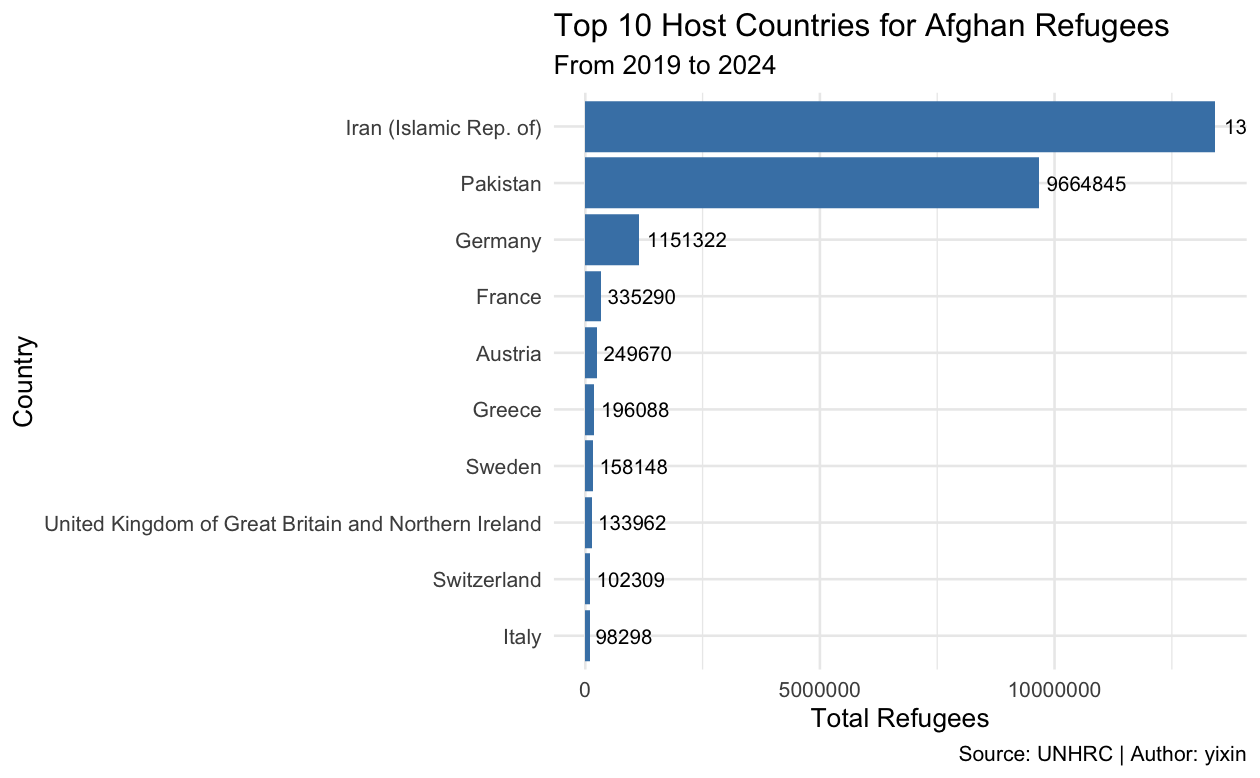
Iran and Pakistan hosted most Afghan refugees between 2019 and 2024.
The data shows that Afghan refugees were not evenly spread across the world. Two countries hosted most of them.
Iran hosted the largest number, with more than 13 million Afghan refugees from 2019 to 2024. It was the biggest host country by a very large margin. Pakistan ranked second and received almost 9.7 million refugees. These two neighbours carried most of the responsibility because they are close to Afghanistan and have long cultural links with Afghan communities. In Europe, Germany hosted more than 1.1 million Afghan refugees, making it the main destination on the continent. Countries such as France, Austria, Greece and Sweden also received Afghan refugees, but the numbers were much lower than those in Iran and Pakistan.
The United Kingdom, Switzerland and Italy hosted smaller totals. Their numbers were between 98,000 and 134,000, which is still meaningful but far below the top three.
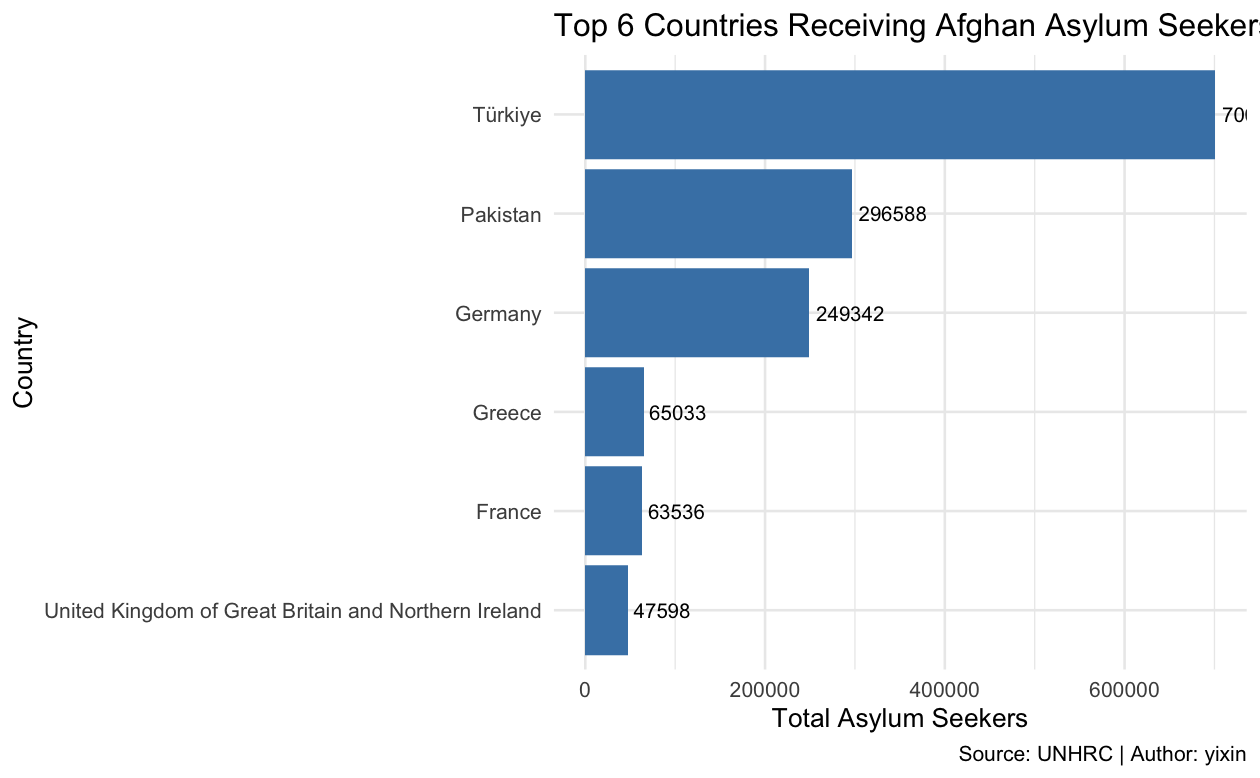
Türkiye and Pakistan received the largest numbers of Afghan asylum seekers, far ahead of European countries.
The data shows that asylum seekers were not concentrated in one region. Instead, a few countries received a much larger share.
Türkiye accepted the highest number of Afghan asylum seekers, with about 701,000 cases. It has been a major entry point for people moving toward Europe, which explains its large share. Pakistan was the second-largest host, with around 296,000 asylum seekers. This reflects its long history of receiving displaced Afghans.
Germany ranked third, with nearly 249,000 asylum seekers. This made it the top destination within Europe. Countries such as Greece and France received much smaller numbers, each taking in around 63,000–65,000 people.
The United Kingdom accepted the fewest among the top six, with about 47,000 asylum seekers. This is still meaningful, but it shows a clear gap between the top two countries and everyone else.
The pattern shows a strong split: Türkiye and Pakistan received far more asylum seekers than European countries, which handled lower but steady levels across the years.
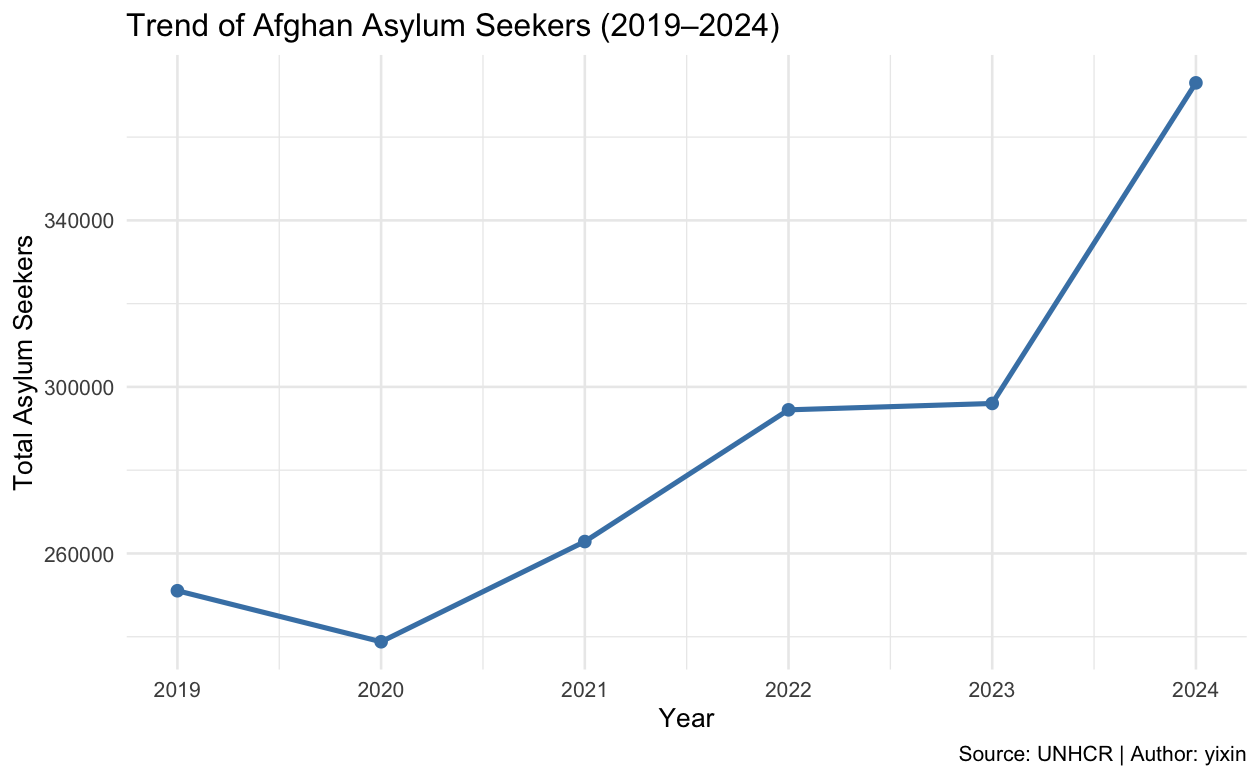
Afghan asylum seeker numbers grew steadily and reached their highest level in 2024
The number of Afghan asylum seekers increased gradually from 2019 to 2024. The total fell slightly in 2020 but started rising again in 2021. The growth became more noticeable after 2022. In 2024, the number reached its highest point in six years, with more than 373,000 asylum seekers.
This trend shows that displacement pressures did not ease over time. Instead, more Afghans continued to leave the country, especially in the most recent year.
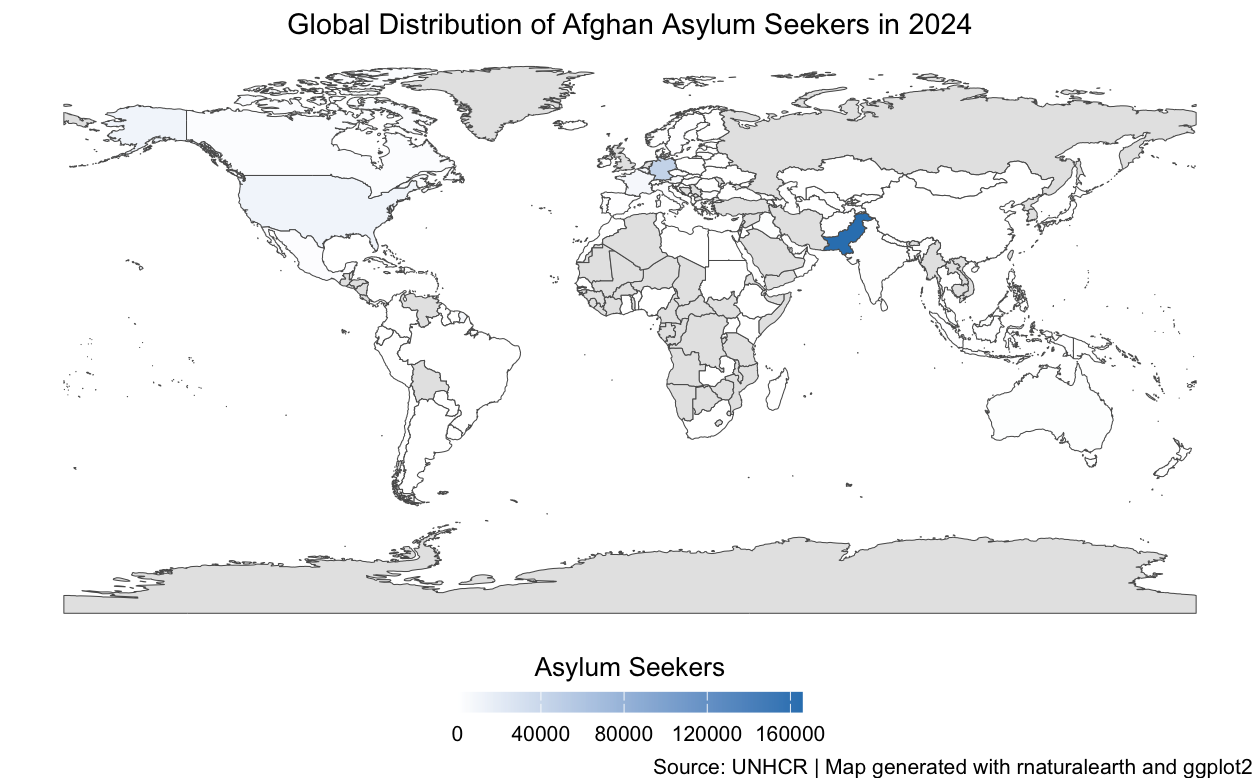
Afghan asylum seekers in 2024 were concentrated in only a few countries
The map shows that Afghan asylum seekers in 2024 were not spread widely across the world. Most countries received very small numbers, while a few stood out with much higher totals. Pakistan hosted by far the largest group, reflecting its long shared border and long-term role as a destination for people leaving Afghanistan. Several European countries, such as Germany and France, also recorded notable numbers, but these were much lower compared with Pakistan.
Many regions, including most of Africa, East Asia, and South America, had almost no Afghan asylum seekers. This uneven pattern suggests that geography, historical migration routes, and established Afghan communities played an important role in shaping where people sought safety in 2024.
Conclusion
The analysis shows that Afghan refugees and asylum seekers were not evenly distributed across the world from 2019 to 2024. Most refugees were hosted by Iran and Pakistan, whose geographic closeness and long-standing ties made them the main destinations. Europe played a secondary role, with Germany receiving the largest numbers in the region. Asylum seeker trends also differed across host countries: Türkiye, Pakistan and Germany saw the highest totals, while many others recorded only small increases. When looking at yearly trends, the overall number of Afghan asylum seekers rose steadily, with a sharp jump in 2024. The global map further highlights that only a few countries received significant arrivals, while most of the world had almost none. Taken together, the findings suggest a strong regional concentration and show how historical routes and proximity continue to shape Afghan displacement patterns.